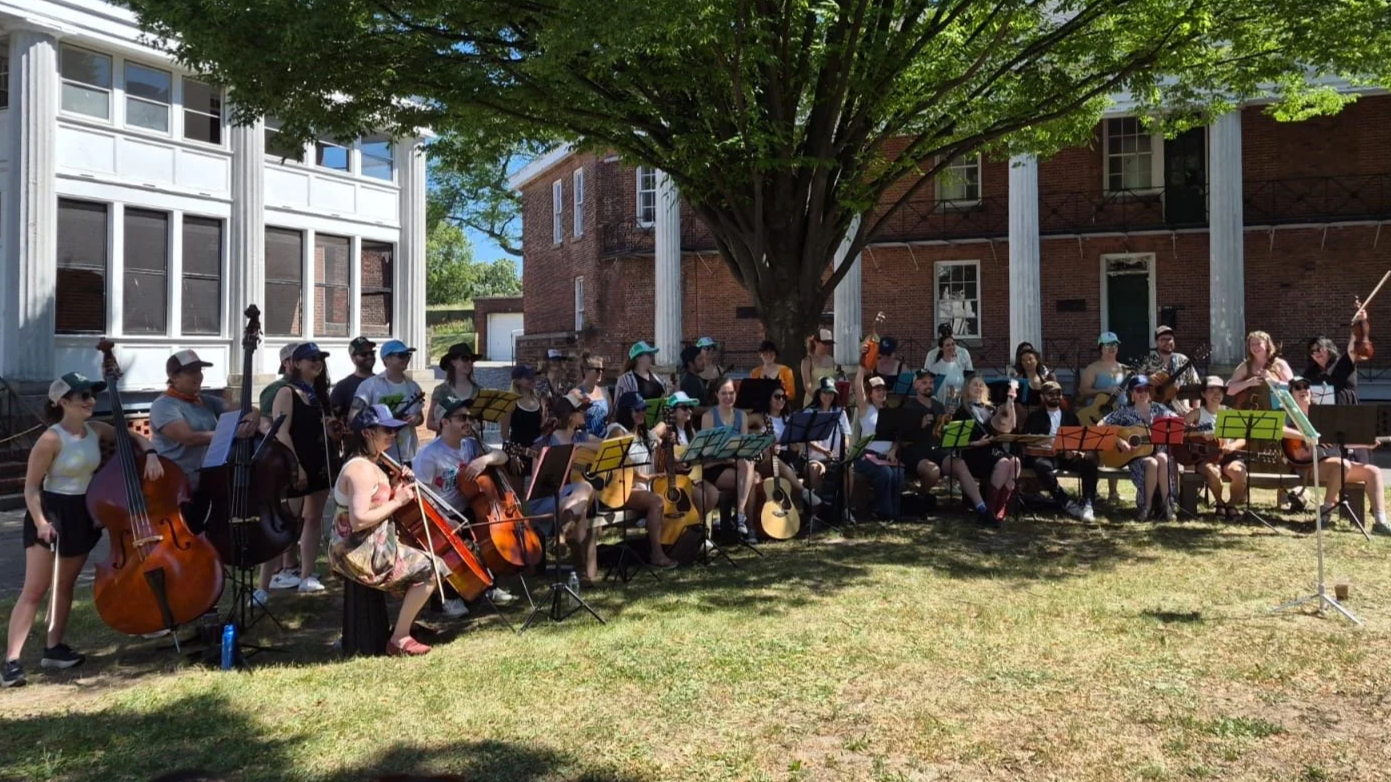
Adult Music Classes & Ensembles in Brooklyn
Bantam Studios offers small-group music classes and ensembles for adults in Park Slope, Brooklyn. Our classes bring students with similar levels of experience together to learn their instruments, study a wide range of music, and develop their skills alongside other adults.
Our Beginner Program provides a structured curriculum for students starting from scratch, while our Studio Program offers ongoing technique classes and ensembles for musicians looking to build on their experience or return to playing after time away. Classes meet weekly, typically in eight-week sessions, with opportunities to rehearse, perform, and continue developing from one session to the next.
Upcoming Classes
2026 Session 5: Music for Film & Television
This session, our adult music ensembles will explore the world of film and television scores, bringing together guitar, ukulele, violin, and chamber musicians for a collaborative musical project.
Over the session, students will work on shared repertoire in smaller rehearsal groups before coming together for a full ensemble performance. We'll also be joined by special guest musicians on woodwinds, brass, and percussion to help bring some of our favorite cinematic sounds to life!
Session 5 Dates: November 30, 2026 – January 23, 2027
Ensemble Rehearsals: Mondays & Tuesdays at Wild East Brewing Co., Brooklyn
Final Performance: Saturday, January 23, 2027 @ Littlefield
2027 Session 1: Winter Salon
Our first session of 2027 will focus on ensemble playing, culminating in an intimate salon-style recital featuring performances by our Studio Program ensembles and Beginner Program students.
Throughout the eight-week session, students will develop their technique, explore new repertoire, and prepare for the final performance. Studio Program ensembles will come together for extended two-hour rehearsals during the final three weeks, giving musicians more time to work as a group and bring their performances together.
Session Dates: February 1 – April 2, 2027
Final Performance: Friday, April 2, 2027
Featuring: Studio Program Ensembles + Beginner Program Students
2027 Session 2: Porch Stomp
We're looking forward to another spring of ensemble playing, with our sights set on returning to Porch Stomp on Governors Island! Our Studio Program ensembles will explore new repertoire, develop their skills, and come together for extended rehearsals as the session progresses.
Beginner Program students will continue building their musical foundations and preparing for an end-of-session performance.
Session Dates: April 12 – June 19, 2027
Final Performance: TBD
Location: TBD
Explore Our Program
Bantam Studios Beginner Program
The Bantam Studios Beginner Program is designed for adults who are picking up an instrument for the first time or returning after time away. Offering Violin, Guitar, and Ukulele classes in Park Slope, Brooklyn, the program brings students with similar levels of experience together to learn the fundamentals of their instrument.
Through a structured curriculum, students develop technique, rhythm, listening skills, and an understanding of music theory while studying a wide range of repertoire and playing with their classmates. Each session builds on the last, preparing students to eventually move into the Studio Program, where they can continue developing their technique and participate in ongoing ensembles.
No previous musical experience is necessary to get started.
-
Violin Foundations I introduces adult beginners to the fundamentals of playing the violin. Students learn how to hold and care for their instruments, establish comfortable posture, develop a proper bow hold, and produce a clear, consistent tone. Through guided exercises, ear training, and group playing, students begin building the coordination and listening skills needed to play with confidence.
Over the session, students will learn the A major scale in first position and prepare French Folk Song for a performance from memory. Each class also includes a short introduction to notable violinists and their musical backgrounds.
Techniques Covered: A major scale, instrument and bow hold, posture, basic bowing, tone production, ear training, tuning, instrument care, and playing in time with a group.
Requirements: No previous violin experience necessary.
-
Violin Foundations II builds on the skills introduced in Foundations I, helping students develop greater comfort, coordination, and control on the instrument. Classes focus on strengthening posture, improving intonation, and developing a more flexible and consistent bow stroke.
Students will explore the G major scale, expand their playing across the E, A, and D strings, and begin working with double stops and written rhythms. The session culminates in a performance of Old Joe Clark from memory. Classes also introduce students to contemporary violinists and opportunities to hear live performances.
Techniques Covered: G major scale, double stops, bow control, straight bowing, left-hand accuracy, rhythm fundamentals, reading rhythmic notation, and ensemble timing.
Requirements: Completion of Violin Foundations I or equivalent experience.
-
Violin Foundations III introduces students to reading music in treble clef while continuing to strengthen the technical skills developed in earlier classes. Students work on coordinating written notation with their playing, improving rhythmic accuracy, and developing a more consistent tone through long-bow exercises.
Over the session, students will practice sight-reading, introduce the fourth finger, explore two-note slurs across strings, and learn to play comfortably while seated. Through three-part rounds and group exercises, students begin developing greater independence within an ensemble. The session concludes with a performance of Dona Nobis Pacem in three parts, using sheet music.
Techniques Covered: Two-octave G major scale, treble clef reading, sight-reading, fourth-finger placement, slurred notes, string crossings, long-tone exercises, rhythm studies, and three-part harmony.
Requirements: Completion of Violin Foundations II or equivalent experience.
-
Violin Foundations IV builds on students' developing music-reading skills while introducing more challenging rhythms, melodic patterns, and left-hand techniques. Students strengthen their ability to interpret written music, maintain a steady pulse, and shape musical phrases through bow control and dynamics.
This session introduces shifting into third position and preliminary vibrato exercises, alongside continued work on sight-reading and tone production. Students will apply these skills to Ashokan Farewell, preparing a performance that emphasizes phrasing, expression, and sustained bow control.
Techniques Covered: Two-octave D major scale, introduction to third-position shifting, sight-reading, whole-bow technique, sustained notes, dynamics, phrasing, and introductory vibrato exercises.
Requirements: Completion of Violin Foundations III or equivalent experience.
-
Violin Applications I introduces students to fiddle traditions, improvisation, and the musical skills needed to participate in informal jam sessions. Building on their technical foundation, students explore how to follow chord progressions, communicate with other players, and develop the confidence to play melodies and solos within a group.
Through pentatonic scales, rhythmic studies, and traditional repertoire, students learn to improvise and respond musically to the players around them. The session features Jolie Blon, a traditional Cajun folk song, and introduces skills that can be applied to Bantam's Folk Jam ensemble.
Techniques Covered: Two-octave A major scale, E major, A major, and D minor pentatonic scales, sight-reading, swung and shuffle rhythms, chord chart reading, soloing, improvisation, and vibrato exercises.
Requirements: Completion of Violin Foundations IV or equivalent experience.
-
Violin Applications II introduces students to chamber music and the technical and musical independence needed to play classical repertoire with multiple parts. Students continue refining tone production, finger articulation, vibrato, and intonation while expanding their ability to move confidently around the fingerboard.
The class focuses on shifting into third position across all four strings, introducing fifth position on the E string, and developing the listening and communication skills essential to chamber playing. Students will explore independent parts through Prelude from Dmitri Shostakovich's Five Duets for Two Violins and Piano, preparing them for future participation in classical ensembles.
Techniques Covered: Two-octave B minor scale, two-octave C and D major scales in third position, third-position shifting on all strings, introduction to fifth position, vibrato, finger articulation, tone production, and chamber music fundamentals.
Requirements: Completion of Violin Applications I or equivalent technical experience.
-
Violin Applications III is the final stage of Bantam Studios' structured Beginner Violin Program, bringing together the technical and musical skills developed throughout the curriculum. Students work with more challenging repertoire, études, and targeted exercises to strengthen their playing and prepare for ongoing participation in the Studio Program.
The class follows a rotating four-session curriculum, allowing students to continue refining their technique, develop greater independence, and build confidence in ensemble settings. Emphasis is placed on shifting, vibrato, complex rhythms, harmony, and the coordination needed for more demanding musical material.
Techniques Covered: Two-octave major and minor scales in G, A, B, C, D, E, and F; third and fifth positions across all four strings; introduction to seventh position; vibrato; complex rhythmic studies; harmony; études; and ensemble preparation.
Requirements: Completion of Violin Applications II or equivalent experience.
What's Next? Students who are ready to move beyond the structured Beginner Program can continue into the Bantam Studios Studio Program, which offers ongoing Violin Techniques classes and ensembles, including Chamber Strings and Folk Jam. Placement is based on playing experience and musical readiness.
-
Guitar Foundations I introduces the essential skills of playing the guitar, from holding and tuning the instrument to developing a clear, consistent tone. Students learn first-position chords, basic picking and strumming techniques, and how to read chord charts and lead sheets. Through familiar songs like "Free Fallin'," "Stand by Me," "Jolene," and "Let It Be," students build the confidence to play along with others.
Techniques Covered: Fretting and left-hand technique, first-position chords, basic picking and strumming patterns, rhythmic notation, chord charts and lead sheets, tuning, instrument care, and playing in time with a group.
-
Guitar Foundations II builds on basic chord playing by introducing single-note melodies, riffs, and reading guitar tablature. Students develop picking dexterity, explore the G major scale, and work with more complex rhythms, including sixteenth notes and syncopation. A rotating selection of songs helps students strengthen their technique, improve their timing, and become more independent in learning new music.
Techniques Covered: Two-octave G major scale, alternate picking, single-note melodies and riffs, tablature, sixteenth-note rhythms, syncopation, double stops, and shifting between positions.
-
Guitar Foundations III brings chordal and melodic playing together while introducing fingerpicking, barre chords, and movable scale patterns. Students explore alternating bass lines, combine melody and accompaniment, and develop greater flexibility across the fingerboard. Through repertoire such as "Freight Train," students build the skills needed for more independent playing and participation in group settings like Folk Jam.
Techniques Covered: Movable major scale patterns, fingerpicking, alternating bass lines, barre chords, combining chords and melody, and developing complete song arrangements.
-
Guitar Applications I is an ongoing class for guitarists who have completed the Foundations sequence or have equivalent experience. Each session introduces new songs, techniques, and musical challenges, giving students the opportunity to strengthen their playing while exploring different styles and approaches. With an emphasis on applying existing skills to real music, the class helps students develop fluency, confidence, and independence on the instrument.
Techniques Covered: Chord voicings, fingerpicking and flatpicking, melodic phrasing, rhythm and groove, movable patterns, arranging, and applying technique to a rotating selection of repertoire.
Class Format: Rolling curriculum with new material each session. Students may enroll for multiple sessions.
-
Perfect for complete beginners! Learn the fundamentals of ukulele playing, including tuning, posture, basic chords, strumming patterns, and rhythm. We'll explore how to read chord charts and build confidence playing familiar songs like "Wagon Wheel" and "Let It Be," working toward a group performance of "You Are My Sunshine."
Experience Level: Complete beginners. No previous musical experience required.
-
Build on your foundational skills with new strumming patterns, barre chords, scales, and swung rhythms. We'll explore how to coordinate singing and playing while developing greater confidence with chord changes and rhythm. Repertoire includes "Don't This Road Look Rough and Rocky," with "Crazy Arms" as our recital piece.
Experience Level: Completion of Ukulele Foundations I or equivalent experience.
-
Take your playing further with syncopated strumming patterns, advanced chord voicings, fingerpicking, and dominant chords. Through scales, exercises, and more challenging repertoire, we'll develop greater independence, musical expression, and coordination between singing and playing. Songs include "Don't Think Twice, It's All Right," with "Somewhere Over the Rainbow" as our recital piece.
Experience Level: Completion of Ukulele Foundations II or equivalent experience.
-
Put your ukulele skills into practice through more complex arrangements and expressive playing. We'll build on familiar techniques while exploring fingerpicking, reading standard notation and tablature, and playing music in less familiar time signatures. With new repertoire and musical challenges each session, students can continue developing their skills before moving into Ukulele Techniques.
Experience Level: Completion of Ukulele Foundations III or equivalent experience.
Bantam Studios Studio Program
The Bantam Studios Studio Program is designed for musicians who want to continue developing their playing, whether they're advancing from our Beginner Program or returning to an instrument they studied years ago. Through ongoing technique classes and ensemble rehearsals, students build on their existing skills while working with other musicians at a comparable level.
Our technique classes work like a musical workout, using guided exercises, études, and focused practice to develop consistency, control, and musical expression. Ensembles give students the opportunity to apply those skills through shared repertoire, listening, rehearsal, and performance.
Both technique classes and ensembles introduce new material each session, so there's always something new to work on. Placement is based on experience and readiness rather than a fixed number of sessions, allowing students to enter the program at an appropriate level and continue developing their playing over time.
-
Violin Techniques I is an ongoing technique class for violinists who have a solid understanding of the fundamentals and want to develop greater consistency, control, and confidence in their playing.
Structured like a musical workout, each class focuses on guided exercises, scales, and études that strengthen left-hand coordination, intonation, shifting, bow control, tone production, and overall musicality. Students will develop more effective practice habits while building the technical skills needed to approach increasingly challenging repertoire.
Exercises and technical goals evolve throughout the year, making this a class students can return to for continued development.
Requirements
Students should be comfortable reading music, playing in first and third positions, and using basic bowing techniques. A working knowledge of scales and the ability to practice independently between classes is recommended.
-
Violin Techniques II is an ongoing technique class for violinists with an established technical foundation who want to refine their playing and tackle more demanding musical challenges.
Classes follow a musical workout format, using scales, études, and targeted exercises to develop advanced left-hand techniques, shifting, vibrato, bow articulation, tone, intonation, and musical expression. Students will focus on greater precision, flexibility, and control while exploring how technique supports phrasing and interpretation.
Technical material changes throughout the year, offering returning students new challenges and opportunities to deepen their musicianship.
Requirements
Students should be comfortable playing in multiple positions, reading more complex repertoire, and working independently on technical exercises and études. Placement is based on technical readiness rather than completion of Violin Techniques I.
-
Guitar Techniques is an ongoing class for players who have completed the fundamentals and want to develop greater confidence, consistency, and versatility on their instrument.
Structured like a musical workout, classes focus on scales, chord transitions, picking and strumming patterns, fretboard knowledge, rhythm, and left- and right-hand coordination. Through guided exercises and études, students will strengthen their technique, develop effective practice habits, and build the skills needed for more challenging repertoire and ensemble playing.
Exercises and technical goals change throughout the year, giving students opportunities to continue developing their skills over multiple sessions.
Requirements
Students should be comfortable reading chord charts, playing common open chords, maintaining a steady rhythm, and performing basic scales and picking patterns. Completion of a Bantam beginner guitar course or equivalent experience is recommended.
-
Ukulele Techniques is an ongoing class for players who have learned the basics and want to develop greater fluency, control, and musical expression on their instrument.
Classes follow a musical workout format, using scales, chord exercises, strumming patterns, fingerpicking, and rhythmic studies to strengthen technique and coordination. Students will work on smoother chord transitions, fretboard knowledge, tone, and musical independence while developing the skills needed for more challenging repertoire and ensemble playing.
Exercises and technical goals evolve throughout the year, allowing students to return for multiple sessions as their playing develops.
Requirements
Students should be comfortable reading chord charts, playing common chords, maintaining a steady rhythm, and using basic strumming patterns. Completion of a Bantam beginner ukulele course or equivalent experience is recommended.
-
Chamber Strings I is an ongoing classical chamber ensemble for violinists, violists, and cellists developing their small-group playing skills. Students explore a rotating selection of classical repertoire while working on sight-reading, period-appropriate articulation, independent part reading, and understanding each instrument's role within the ensemble.
Emphasis is placed on listening, communication, rehearsal techniques, and musical collaboration. Students are welcome to return for multiple sessions as repertoire changes and their ensemble skills develop.
Requirements
Students should have a working understanding of triplets, dotted eighth and sixteenth-note rhythms, hooked bowing, and the full dynamic range (pp–ff), along with the ability to sight-read quarter and eighth notes at approximately 65 BPM.
Violin & Viola: Comfortable playing in third position, with some familiarity with fifth position.
Cello: Familiarity with extensions, half position, and fourth position.
-
Chamber Strings II is an ongoing classical chamber ensemble for violinists, violists, and cellists with established ensemble experience and greater technical independence. The group explores more demanding repertoire, with an emphasis on interpretation, phrasing, articulation, balance, and collaborative rehearsal.
Repertoire changes each session, allowing returning students to explore new works, deepen their musicianship, and continue developing as ensemble players.
Requirements
Previous chamber ensemble experience, strong independent reading skills, and the ability to prepare and maintain individual parts within a group. Placement is based on musical readiness rather than completion of Chamber Strings I.
-
Folk Jam is an ongoing ensemble for guitarists, violinists, mandolin players, banjo players, and bassists who are comfortable with their instruments and ready to explore playing in a traditional folk jam setting.
Students will develop skills in following chord progressions, reading chord charts, accompanying other musicians, and understanding their instrument's role within a group. Emphasis is placed on listening, rhythm, musical communication, and building the confidence to participate in informal jam sessions.
Repertoire changes each session, giving returning students opportunities to explore new tunes, styles, and musical traditions while continuing to develop their ensemble skills.
Requirements
Students should be comfortable reading chord charts and have playing skills equivalent to Guitar Foundations I, or higher. Previous jam experience is not required.
Open to: Violin, Guitar, Mandolin, Banjo, and Bass.
-
Ukulele Orchestra explores music through layered arrangements featuring melody, harmony, rhythm, and accompaniment. Students develop their technique, listening, and ensemble skills while working on a rotating selection of music, from familiar songs to unexpected instrumental arrangements. Singing is welcome but never required, and each session brings new repertoire and opportunities to perform.
Experience Level: Ukulele Foundations I or equivalent experience recommended.
Class Format: Ongoing ensemble with new repertoire each session.
Contact Us
Have questions about class placement? Get in touch!
Whether you're brand new to an instrument, returning after some time away, or bringing experience from elsewhere, we're happy to help you find the right fit.